Newborn Jaundice & How Tech is Bringing Healing Home
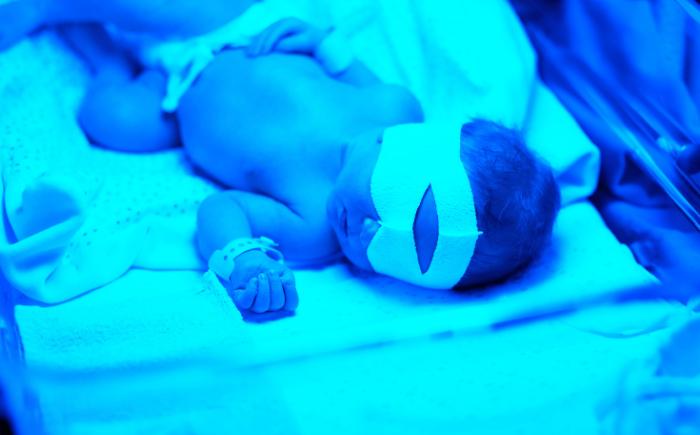 Seeing your newborn turn yellow can be a frightening sight, but there’s no need to panic. Neonatal jaundice affects around 85% of premature infants, and is caused by a temporary buildup of a natural yellow pigment called bilirubin in the baby’s blood. Infant jaundice is highly treatable, and newborn phototherapy is the standard for helping babies clear it safely.
When our bodies break down old red blood cells, they create bilirubin. Bilirubin doesn’t dissolve in water on its own, it must be transported through the bloodstream bound to a protein. In adults, a mature liver easily processes this pigment by attaching a sugar molecule to make it water-soluble so it can be flushed out through bile and stool. However, a newborn baby’s liver is still immature and often cannot keep up with the workload during those first few days of life. Bilirubin has a strong chemical affinity for elastin, the structural protein found in connective tissues. Since the skin and the sclera (whites of the eyes) are packed with elastin, they bind the pigment tightly and turn yellow!
This is where the blue light therapy for jaundice comes in. Phototherapy uses specific wavelengths of blue-green light to bypass the liver entirely. These safe wavelengths strike the baby’s bare skin and change the structure of bilirubin molecules. In their natural state, these molecules are tightly coiled up and fat-soluble. The wavelength gently forces these coils to unravel and transform into a water-soluble molecule instead. In this new water-soluble form it can dissolve directly into the bloodstream without needing the liver’s help.
At the same time, the light triggers a slower but permanent change, reshaping the atoms into a harmless compound called lumirubin. The light can also trigger a minor reaction with oxygen in the skin, breaking down small amounts of remaining pigment. Because all of these light-altered pieces are now water-soluble, the baby’s body easily filters them out through urine and stool. This is why frequent feedings are so important, as the more a baby eats, the faster the jaundice clears!
Previously, treating jaundice in babies meant keeping your infant under bright overhead lamps in a hospital nursery. Today, medical technology giants like GE HealthCare manufacture innovative, portable fiber-optic devices like the GE HealthCare BiliSoft Phototherapy System. Instead of an overhead lamp, these devices feature a soft, flexible, glowing blue mat. Hospitals and pediatric clinics can buy or lease these systems from medical suppliers to distribute to families, allowing babies to be wrapped right inside the light blanket like a cozy sleeping bag.
This portable technology has also paved the way for “virtual wards”, hospital-level care delivered at home. Virtual wards are becoming increasingly popular in modern healthcare. As highlighted by Infant Journal, virtual wards allow stable babies to receive high-quality, intensive home phototherapy in the comfort of their own homes. Healthcare teams can monitor the baby remotely through video calls and check-ins, allowing families to avoid long hospital stays. Because the glowing pad wraps directly around the infant, parents can safely pick up, hold, cuddle, and breastfeed their baby without interrupting the healing light therapy. Treatment remains effective, and hospital stay shortens. It’s a model that balances clinical safety with the simple reality that newborns and their parents do better when they can heal at home!
Frequently Asked Questions (FAQ)
- Does every baby with jaundice need phototherapy?
No. Most newborns experience mild physiological jaundice that peaks and clears up on its own within two weeks as their liver matures. Doctors only recommend phototherapy if a blood or skin test shows bilirubin levels have crossed a safe threshold based on the baby’s hours of life and weight. - Is home phototherapy as effective as hospital treatment?
Yes. Clinical data published in journals such as the Infant Journal and shared by the NHS Greater Glasgow and Clyde Guidelines indicates that home-based systems are equally effective for stable, near-term infants. They successfully lower bilirubin levels at a rate comparable to traditional hospital overhead lamps. - Can I buy a phototherapy sleeping bag online myself?
No, these are not available to buy directly as a consumer. High-intensity devices like the BiliSoft system are regulated medical equipment sold by manufacturers to hospitals, pediatric clinics, or certified Durable Medical Equipment (DME) providers. If your baby qualifies for home care, your hospital or pediatrician will prescribe and provide the unit to you. - Does my baby need to wear eye protection with a “sleeping bag” mat?
If a baby is wrapped inside a fiber-optic blanket and the light is completely enclosed against their skin, eye patches may not be required. However, clinical safety tutorials from health networks like the NHS BiliSoft Tutorial note that manufacturers still strongly recommend soft eye protectors to shield the infant’s eyes from any stray blue light that might peek through the wrapping. Always follow your specific healthcare team’s instructions.
