

How Maternal Nutrition Reaches Your Preemie Through Milk

A new study by Dailey-Chwalibóg et al. (2026), helps us understand exactly how the nutrients a mother eats ends up in her milk and then into her baby’s bloodstream. The study used data from three randomized trials in Burkina Faso, Pakistan, and Tanzania as part of the International Milk Composition (IMiC) Consortium.
How does this work?
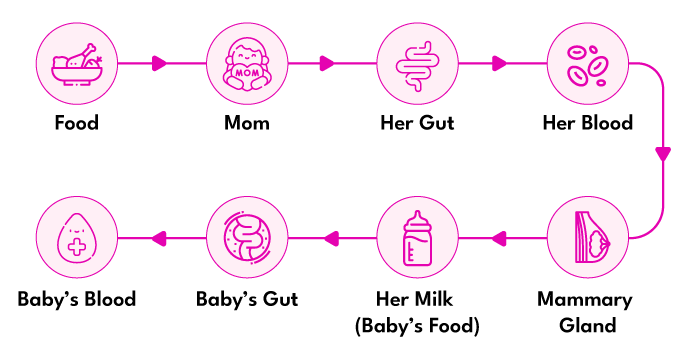
First it begins with what food the mother eats. Researchers provided mothers with Balanced Energy-Protein (BEP) supplements: a fortified peanut butter protein bar with a prenatal vitamin mixed in. Each daily serving provided 393 calories and 14.5 grams of protein alongside a blend of vitamins and minerals.
Once a mother eats, her digestive system breaks down the food into smaller components: vitamins, minerals, fatty acids, amino acids, and thousands of other metabolites. These nutrients are absorbed through the gut and enter her bloodstream.
The mammary gland draws nutrients from the mother’s blood and packages them into milk. The study found that human milk is actually remarkably resistant to change. Despite giving mothers a substantial nutritional supplement, the total amount of fat, protein, carbohydrates, and energy in the milk stayed largely the same. Some key components did change:
- B Vitamins: The BEP caused levels of B vitamins in milk to skyrocket. In one trial, vitamin B3 increased by nearly 184%. B vitamins are also essential for:
- Brain development: B vitamins like B6, B12, and folate are critical for building and maintaining the nervous system. They help create neurotransmitters, the chemical messengers that allow brain cells to communicate.
- DNA and cell division: B vitamins are needed for making DNA and for cell division, which is especially important for a rapidly growing premature infant.
- Red blood cell production: B6, B12, and folate are needed to make healthy red blood cells that carry oxygen throughout the body.
- Energy metabolism: B1, B2, B3, B5, and B7 are directly involved in the metabolic pathways that turn carbohydrates, fats, and proteins into energy.2
- Triglycerides: The study found that mothers who took BEP shifted their milk fat composition. Their triglycerides (fat molecules) became richer in polyunsaturated fatty acids specifically: a-Linolenic acid (ALA), γ-Linolenic acid (GLA) and Stearidonic acid. Together, these polyunsaturated fatty acids contribute to the overall quality of milk fat and support the infant’s developing brain, eyes, and immune system. 3
- Proteins: The researchers also found that proteins from the intracellular machinery of mammary cells were less abundant in the milk of mothers who took BEP. This could support a healthier mammary environment, and that shows up as fewer intracellular proteins in milk. It is not a sign that the milk is worse or less nourishing.1
What’s within the milk that actually reaches the baby?
Within this study three specific metabolites appeared in all: maternal blood, milk, and infant blood:
- Citrate: a key molecule in energy metabolism. Cells use a cycle called the TCA cycle to turn food into usable energy. 4
- 4-Hydroxy-2-oxoglutarate: A human metabolite produced while the body is processing certain amino acids, particularly 4-hydroxyproline.It is involved in metabolic pathways.5
- Octenoylcarnitine: It plays a role in fatty acid oxidation. When you see acylcarnitines like this, it usually means fat is being processed and used as fuel.6
Two of these (citrate and 4-hydroxy-2-oxoglutarate) were actually detected in the BEP supplement itself. This means that a nutrient from a food supplement can travel all the way through a mother’s body and be detected in her baby’s bloodstream.
This study provides a clear, traceable pathway for how maternal nutrition reaches a preterm infant: from a fortified supplement, through the mother’s bloodstream and mammary glands, into her milk, and finally into the infant’s own bloodstream. The central finding is that human milk is remarkably resilient; total macronutrients and energy content remained largely stable despite substantial nutritional supplementation. However, the quality of the milk is not fixed. Maternal energy-protein supplements significantly increased B-vitamin levels in milk and shifted milk fat composition toward polyunsaturated fatty acids that support brain, eye, and immune development. Also, specific metabolites were detected across maternal blood, human milk, and infant blood, demonstrating that nutrients from maternal supplements travel the full biological route to the baby.
For premature infants in low-resource settings, these findings suggest that maternal nutritional interventions can meaningfully improve the micronutrient and fatty acid quality of breast milk without disrupting its overall macronutrient balance, offering a practical pathway to better support growth and development.
REFERENCES
- Dailey-Chwalibóg, T., Mertens, A., Fehr, K., Shu, C. H., Jauhal, A., Manus, M. B., Deng, L., Toe, L. C., Muhammed, A., Pasha, A., Shafiq, Y., Iqbal, N., Khan, W., Nisar, M. I., Baxter, J. B., Beggs, M. R., Sundararaman, N., Van Eyk, J. E., Bode, L., Hubbard, A., … Azad, M. B. (2026). Nutritional interventions’ impacts on human milk: Three trials in low-resource settings. Science (New York, N.Y.), 10.1126/science.aee9284. Advance online publication. https://doi.org/10.1126/science.aee9284
- Allen, L. H., Shahab-Ferdows, S., Moore, S. E., Peerson, J. M., Kac, G., Figueiredo, A. C., Dror, D. K., Michaelsen, K. F., Islam, M. M., Nije, F., Hampel, D., & MILQ Study Consortium (2025). Reference Values for B Vitamins in Human Milk: The Mothers, Infants and Lactation Quality (MILQ) Study. Advances in nutrition (Bethesda, Md.), 16 Suppl 1(Suppl 1), 100500. https://doi.org/10.1016/j.advnut.2025.100500
- Innis, S. M. (2007). Human milk: Maternal dietary lipids and infant development. Proceedings of the Nutrition Society, *66*(3), 397–404. https://www.cambridge.org/core/journals/proceedings-of-the-nutrition-society/article/human-milk-maternal-dietary-lipids-and-infant-development/FD36C50F12B5D28EE9A6559EA1AC4E9D
- Granchi, D., Baldini, N., Ulivieri, F. M., & Caudarella, R. (2019). Role of Citrate in Pathophysiology and Medical Management of Bone Diseases. Nutrients, 11(11), 2576. https://doi.org/10.3390/nu11112576
- National Center for Biotechnology Information (2026). PubChem Compound Summary for CID 5459960, 4-Hydroxy-2-oxoglutarate. Retrieved October 15, 2026 from https://pubchem.ncbi.nlm.nih.gov/compound/4-Hydroxy-2-oxoglutarate.
- Longo, N., Frigeni, M., & Pasquali, M. (2016). Carnitine transport and fatty acid oxidation. Biochimica et biophysica acta, 1863(10), 2422–2435. https://doi.org/10.1016/j.bbamcr.2016.01.023