
Congenital Heart Defects (CHDs): Risks, Prevention, and Special Care for Preterm Infants
Congenital heart defects (CHDs), are heart conditions that affect the heart’s structure and how it pumps blood. CHDs are the most common type of birth defect, in Europe alone CHDs affect around 36,000 babies every year.1 CHDs range from mild to critical. Critical CHDs may require surgery or other procedures within the first year of life.
Severe CHD is 3 times more common in premature infants (1.5%) than in the general newborn population (approx. 0.5%)2. When compared to preterm infants of the same gestational age without CHD, babies with severe CHD faced a much higher risk of major complications, namely an increased risk of Bronchopulmonary dysplasia (BPD), severe brain bleeding (IVH), necrotizing enterocolitis (NEC), and brain injury (PVL).2
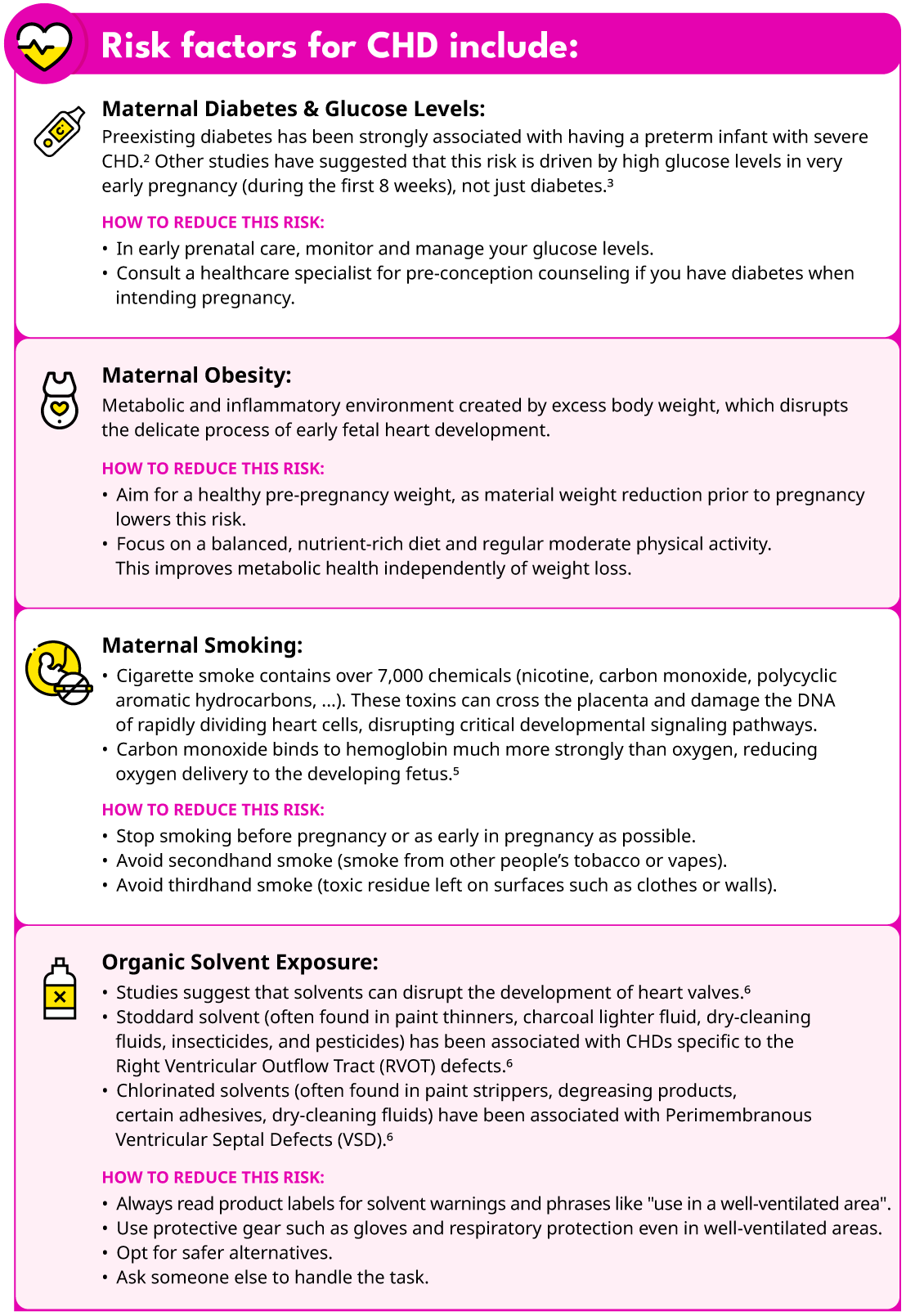
A baby’s heart begins to form just 5-6 weeks after conception, with the basic structure being complete by 8 weeks. This means the heart begins forming before many people are even aware of their pregnancy, which is why maternal health factors before conception and during the first critical weeks are so influential in potentially preventing CHD.
For infants born prematurely with a congenital heart defect, there exists a physiological challenge: managing both the immaturity of their organs (such as the lungs and brain) alongside a heart that isn’t working efficiently.7 This complexity is well recognized in neonatology, and it has led to the development of specialized, integrated care protocols within modern neonatal intensive care units (NICUs). Key principles for this include:
- Delayed intervention: For many premature infants with CHDs, surgeons often postpone major corrective surgery. This allows critical time for growth and physiological maturation in the NICU, a period carefully managed through tailored nutrition, medication, and advanced monitoring.
- Integrated Care: Often, a multidisciplinary team coordinates expertise to support the infant’s overall development with a strategic plan to eventually address the congenital cardiac condition.
While congenital heart defects present a significant early challenge, 85-90% of children with CHDs survive into adulthood.8 For premature infants with CHD, access to the modern NICU protocols helps them to be a part of this growing statistic.
REFERENCES
- Hoffman JL, Kaplan S. The incidence of congenital heart disease. J Am Coll Cardiol. 2002;39(12):1890-1900.
- Aly, S., Qattea, I., Kattea, M. O., & Aly, H. Z. (2024). Neonatal outcomes in preterm infants with severe congenital heart disease: a national cohort analysis. Frontiers in pediatrics, 12, 1326804. https://doi.org/10.3389/fped.2024.1326804
- Øyen, N., Diaz, L. J., Leirgul, E., Boyd, H. A., Priest, J., Mathiesen, E. R., Quertermous, T., Wohlfahrt, J., & Melbye, M. (2016). Prepregnancy Diabetes and Offspring Risk of Congenital Heart Disease: A Nationwide Cohort Study. Circulation, 133(23), 2243–2253. https://doi.org/10.1161/CIRCULATIONAHA.115.017465
- Mills, J. L., Troendle, J., Conley, M. R., Carter, T., & Druschel, C. M. (2010). Maternal obesity and congenital heart defects: a population-based study. The American journal of clinical nutrition, 91(6), 1543–1549. https://doi.org/10.3945/ajcn.2009.28865
- Correa, A., Levis, D. M., Tinker, S. C., & Cragan, J. D. (2015). Maternal cigarette smoking and congenital heart defects. The Journal of pediatrics, 166(4), 801–804. https://doi.org/10.1016/j.jpeds.2015.01.013
- Gilboa, S. M., Desrosiers, T. A., Lawson, C., Lupo, P. J., Riehle-Colarusso, T. J., Stewart, P. A., van Wijngaarden, E., Waters, M. A., Correa, A., & National Birth Defects Prevention Study (2012). Association between maternal occupational exposure to organic solvents and congenital heart defects, National Birth Defects Prevention Study, 1997-2002. Occupational and environmental medicine, 69(9), 628–635. https://doi.org/10.1136/oemed-2011-100536
- Levy, P. T., Thomas, A. R., Wethall, A., Perez, D., Steurer, M., & Ball, M. K. (2022). Rethinking congenital heart disease in preterm neonates. NeoReviews, *23*(6), e373–e387. https://doi.org/10.1542/neo.23-6-e373
- American Academy of Pediatrics. (2025, August 14). Lifelong care for people living with CHDs. https://www.aap.org/en/patient-care/congenital-heart-defects/congenital-heart-public-health-consortium/health-supervision-for-adolescents-and-young-adults/


Leave a Reply
Want to join the discussion?Feel free to contribute!