Beyond Food: How Dr. Katherine Hinde is Revolutionizing Our Understanding of Breast Milk
Dr. Katherine Hinde, a researcher at the Comparative Lactation Lab at Arizona State University, is shifting how we understand mammal mother’s milk. Moving beyond milk’s role as mere nutrition, Dr. Hinde’s research redefines it as a vital form of food, medicine, and a developmental signal. Through her popular blog “Mammals Suck… Milk!”, she translates evolutionary biology into critical insights for clinical practice and infant health policy.¹
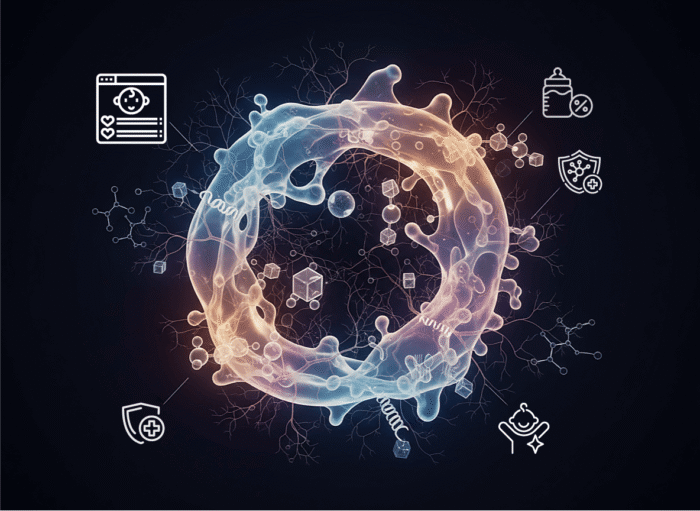
Dr. Hinde’s work reframes human milk as “food, medicine, and signal” all in one:
- As FOOD: Human milk provides a blend of nutrients needed for rapidly developing brains and bodies.
- As MEDICINE: Human milk is a living immune system. Human milk delivers antibodies to fight pathogens and prebiotics to feed the good bacteria colonizing an infant’s sterile gut. This builds the baby’s best defense shield.
- As a SIGNAL: Human milk contains hormones and other bioactive molecules that act like an instruction manual, helping regulate the baby’s metabolism, stress response, and long-term development.2
Dr. Hinde believes that milk should not only be viewed as “just calories and protein”, but rather as a bioactive, living fluid tailored by evolution over 200 million years. This is evident in milk’s role as a signal, which facilitates a continuous physiological dialogue between mother and infant. As an example, the hormone oxytocin in milk not only aids lactation but also promotes bonding between mother and infant, and reduces stress, with cortisol levels helping calibrate the infant’s own stress-response system.3 Other studies have shown that when a baby is sick, their body sends signals that cause the white blood cell count (leukocytes and macrophages) in their mother’s milk to surge, creating a customized immune boost. When the illness passes, these levels return to normal.4
Dr. Hinde’s work for premature infants has debunked the concept of standardised milk fortification. Her research reveals that milk’s “biological recipe” can differ based on the infant’s sex, with sons and daughters receiving unique formulations. This stands in stark contrast to the common practice in many NICUs, where donor milk pools and standard fortification protocols create a homogenized, “one-size-fits-all” model. Dr. Hinde calls for future personalized milk fortification, where each infant’s milk is treated as dynamic and individual, with fortifiers adjusted precisely.2 This is where the Preemie System can make such precision possible, tailoring milk fortification for every infant’s unique needs.
She emphasizes that conditions such as preterm birth, C-sections, maternal obesity, and endocrine disorders can disrupt the underlying biology of lactation.5 Furthermore, mothers of premature babies are often recovering from a traumatic birth while separated from their baby – a scenario far from the ideal breastfeeding initiation. Dr. Hinde states that only 1 in 5 babies in the U.S. is born in a “Baby-Friendly” hospital that provides optimal support for infant feeding. For mothers of preemies, knowledgeable clinical support for establishing and maintaining milk supply is a medical necessity for their child’s health, yet it remains largely inaccessible.2
Dr. Hinde points out that there are fewer research articles on breast milk and lactation than on coffee or wine; in fact, we know over twice as much about erectile dysfunction as we do about lactation.2 This research gap has direct consequences in the NICU, where a preemie faces the challenge of achieving growth rates similar to in-utero development; their outcome is hampered by our incomplete scientific understanding.
Dr. Katherine Hinde’s advocacy tells us that breast milk is more than food, it’s vital medicine and a developmental signal essential for preemie survival! To close the research gap and transform care, we must move toward personalised nutrition and stronger systemic support for mothers and infants.
To learn more about Katie Hinde’s work explore her blog, “Mammals Suck…Milk!”.
REFERENCES
- Arizona State University. (n.d.). Katie Hinde. ASU Search. Retrieved January 17, 2026, from https://search.asu.edu/profile/2740008
- Hinde, K. (2017, March). What we don’t know about mother’s milk [Video]. TED Conferences. https://www.ted.com/talks/katie_hinde_what_we_don_t_know_about_mother_s_milk
- World Health Organization. (2009). Infant and young child feeding: Model chapter for textbooks for medical students and allied health professionals. https://www.ncbi.nlm.nih.gov/books/NBK148970/
- Wisner, W. (2022, April 8). Does breast milk change when your baby is sick? Healthline. https://www.healthline.com/health/childrens-health/does-breast-milk-change-when-baby-is-sick
- Krebs, N. F., Belfort, M. B., Meier, P. P., Mennella, J. A., O’Connor, D. L., Taylor, S. N., & Raiten, D. J. (2023). Infant factors that impact the ecology of human milk secretion and composition – a report from “Breastmilk Ecology: Genesis of Infant Nutrition (BEGIN)” Working Group 3. The American journal of clinical nutrition, 117 Suppl 1(Suppl 1), S43–S60. https://doi.org/10.1016/j.ajcnut.2023.01.021