Preventing Mother-to-Child Transmission of HIV
December is AIDS Awareness Month, a time to raise awareness, educate, and take action in the fight against HIV/AIDS.1 For women living with HIV, the possibility of transmitting the virus to their baby can be a concern. But there is good news: with the right steps, the risk of mother-to-child transmission (MTCT) can be reduced to less than 1%.2 Here’s what you need to know to protect your health and baby.
Antiretroviral Therapy (ART): The Key to Prevention
Antiretroviral therapy (ART) is the use of HIV medicines to treat HIV infection. For pregnant individuals with HIV, ART is the most effective way to reduce the risk of perinatal transmission, i.e. mother-to-child transmission (MTCT).
How does ART work?
- HIV medications stop the virus from replicating, lowering the amount of HIV in your body, a process known as viral load suppression.
- The goal of ART is to achieve an undetectable viral load, when the level of HIV in the blood is too low to be detected by a test.
- An undetectable viral load during pregnancy and childbirth lowers the risk of perinatal transmission to less than 1%.
- Viral Load Suppression also protects your partner as people with an undetectable viral load cannot transmit HIV through sex.
When to start ART?
- Before Pregnancy: Starting ART before pregnancy or during conception can significantly reduce the risk of transmission.
- During Pregnancy: The earlier HIV medicines are started, the more effective they are at preventing perinatal transmission.
- During Delivery: If your viral load is undetectable, a vaginal delivery is generally safe. In some cases, a cesarean section may be recommended to further reduce transmission risk.
- After Birth: Your baby will receive HIV medication for 2-6 weeks after delivery to provide additional protection.
- The specific medicines / duration on the birthing parent’s viral load and adherence to ART during pregnancy.
Cesarean Section: When Is It Recommended?
Most pregnant people with HIV can have vaginal deliveries. However, in certain situations, a cesarean section (C-section) is recommended to reduce the risk of MTCT:
- If your viral load is high (more than 1,000 copies/mL) near the time of delivery.
- If your viral load is unknown near time of delivery.
- If you have other complications that would make a C-section a safer choice.
Discuss your options with your healthcare provider to determine the best delivery plan for you and your baby.
Breastfeeding and HIV: Making an Informed Choice
Breastfeeding is a personal decision. If you choose to breastfeed:
- Taking ART and maintaining an undetectable viral load reduces the risk of transmission to less than 1%. However, the risk is not zero.
- For a zero-risk alternative, consider properly screened donor breast milk.
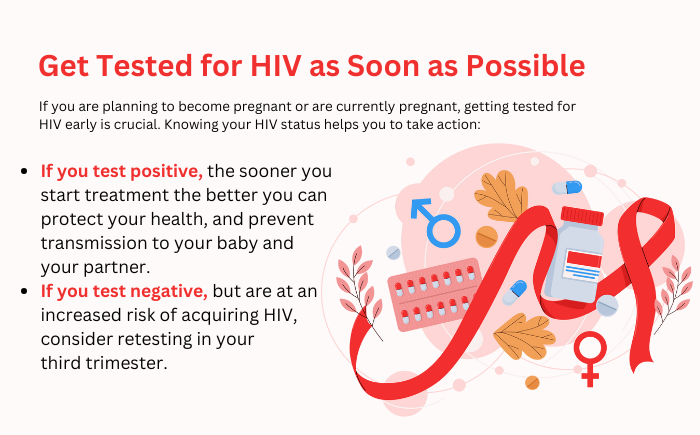
If you’re pregnant or planning to become pregnant, talk to your healthcare provider about HIV testing and treatment options. With the right steps, you can protect your health and give your baby the best possible start in life.
REFERENCES
- Illinois Department of Central Management Services. (2023, December). December is AIDS Awareness Month. Be Well Illinois.
https://cms.illinois.gov/benefits/stateemployee/bewell/awarenessmatters/december2023-aids-awareness-month.html - HIV.gov. (n.d.-a). Preventing mother-to-child transmission of HIV. U.S. Department of Health & Human Services.
https://www.hiv.gov/hiv-basics/hiv-prevention/reducing-mother-to-child-risk/preventing-mother-to-child-transmission-of-hiv#:~:text=If%20you%20have%20HIV%20and,can%20have%20a%20normal%20delivery - HIV.gov. (n.d.-b). Preventing mother-to-child transmission of HIV. U.S. Department of Health & Human Services.
https://www.hiv.gov/hiv-basics/hiv-prevention/reducing-mother-to-child-risk/preventing-mother-to-child-transmission-of-hiv#:~:text=Taking%20HIV%20medicine%20and%20getting,prevent%20transmission%20to%20your%20baby
Leave a Reply
Want to join the discussion?Feel free to contribute!